
English Springer Health
English Springer Spaniels invariably live long, healthy and happy lives and health issues are uncommon. Nevertheless there are inherited conditions that exist and for which testing is available as a means of reducing or eliminating the risk of producing affected dogs. It is also important to point out that there are some diseases present in the breed for which there are no tests currently available.
In January 2025, the Kennel Club launched a new Health Standard to help breeders prioritise health tests that should be carried out before breeding and to indicate to puppy buyers the tests that should have been carried out in their chosen breed. A responsible breeder will want to improve the health of the breed by breeding from only the healthiest dogs and both mother (dam) and father (sire) should have been tested or screened before mating and the results carefully considered.
The Kennel Club Health Standard based its findings on information input by vets and insurance companies and it is worth noting that English Springer Spaniels have been considered as 'one breed' with no differentiation being made between show and working types. Given that the two types are very different, both physically and genetically, they can also be affected by differing health issues. For example, working-bred dogs are more likely to suffer from elbow issues than their show-bred cousins and yet elbow screening appears as a priority test on the newly-initiated KC Health Standard for the breed as a whole.
Below you can find further information on the tests making up the Health Standard and please note that 'Good Practice' tests are higher priority, while 'Best Practice' are considered of lower priority.
_edited.png)
The KC Health Standard
GOOD PRACTICE
Eye Scheme
The English Springer Spaniel, like many other breeds, should be regularly eye-tested using the BVA/KC eye schemes. This is a clinical examination carried out by a qualified ophthalmologist. Generally, for the English Springer, the eye specialist is looking for signs of PRA and Goniodysgenesis. Testing for PRA should be carried out annually, and the Gonio test once every three years.
The term 'Progressive Retinal Atrophy' describes different types of inherited degeneration of the retina and in the case of the English Springer an opthalmogist will be looking for the following forms:
Generalised Progressive Rod-Cone Degeneration (GPRA) affects the photoreceptor (light sensitive) cells. Dogs that are affected will eventually become totally blind. It is generally believed that in the English Springer Spaniel, it is a late onset condition, usually appearing after the dog is five years of age.
Retinal Pigment Epithelial Dystrophy - RPED (also known as Centralised PRA - CPRA)
The abnormality is in the retinal pigmented epithelium (RPE). The photoreceptor cells will also degenerate eventually. The rate of vision loss is much slower than with generalised PRA, and not all dogs become totally blind. CPRA is detectable between the ages of 12 - 18 months by clinical eye examination.
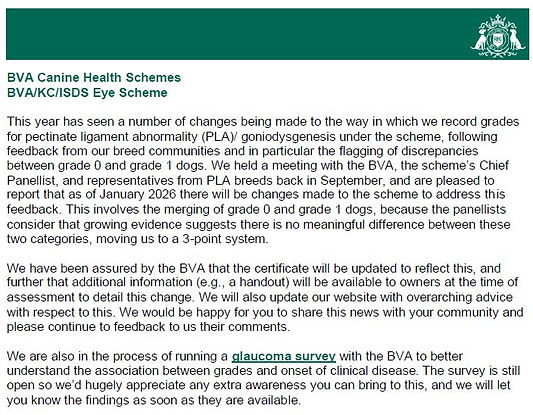
The second condition is Goniodysgenesis and the eye exam for this is known as Gonioscopy. Here, the opthalmologist will look for signs that the dog may go on to be affected by a painful disease known as primary glaucoma. Glaucoma is increased pressure within the eye caused by a build up of fluid. This can happen when drainage angles in the eye are insufficient and how badly a dog's eye is affected will be assessed and graded. This grade can be used to help make breeding decisions that reduce the risk of producing puppies that may go on to be affected by primary glaucoma.
PLEASE NOTE: From January 2026, Gonioscopy results will be graded 1, 2 or 3 only. Any current '0' grades will be amended to '1' Please see below the Kennel Club notification regarding the forthcoming changes:
Elbow Dysplasia
Elbow dysplasia is a complex inherited condition where the elbow joint develops incorrectly. As the dog ages, the joints deteriorate, causing varying degrees of pain, discomfort, stiffness and lameness. Elbow dysplasia is controlled by a number of different genes but is also likely to be influenced by environmental factors such as diet and exercise.
The most reliable way of determining the health of a dog’s elbows is by having your dog x-rayed and assessed by a specialist. The x-ray will be taken under anaesthesia or sedation and the results sent for grading. Elbow screening is a one-off test. The British Veterinary Association and the KC Elbow Dysplasia Scheme assesses the dog's x-rays to look for abnormalities in the elbow joint. Each x-ray is assessed by a panel of experts and the degree of elbow dysplasia present is indicated by a scale of 0 to 3 (0 being the best and 3 being the most severe).
Unfortunately, it is very difficult to build up an accurate picture of how much elbow dysplasia is an issue in English Springers as so few dogs have been screened. In the last 15 years in fact, only 421 Springers have been x-rayed. Of those, 391 of them achieved the best score of 0.
Hip Dysplasia
Hip scoring forms part of four 'Good Practice' tests that are required to meet the Kennel Club Health Standard for ESS from the start of 2025. Hip dysplasia is a complex condition where the dog's hip joint develops incorrectly. Hip dysplasia is controlled by a number of different genes but also influenced by environmental factors such as diet and exercise.
Dogs are usually screened for hip dysplasia once they reach the age of 12 months and the resulting x-rays are submitted to the BVA/KC Hip Dysplasia Scheme. Each x-ray is awarded a number, a total of the points awarded for each of the nine radiographic features of the hip joints. The lower the score, the less the degree of hip dysplasia present. The minimum or best score is zero and the maximum is 106.
The 'breed median score' is calculated from all the scores recorded for any given breed and shows the overall hip status of that breed. In English Springers it is very fair to say that screening for Hip Dysplasia is uncommon. In the last 15 years only 820 dogs have been screened and when you consider the number of puppies registered overall, the screened dogs make up a very small percentage. That said, based on the dogs that were x-rayed, the 5 year median score for English Springer Spaniels (to 31st December 2024) was 10. The 15 year median score is also 10, based on the total of 820 dogs tested. Individual scores ranged from 0 - 92.
Worth considering however, is that many published studies show that only around 20-30% of the variation in hip scores can be accounted for by variation in genes while the remainder reflects the effects of non-genetic factors. This means that it is more likely that a hip score will reflect an environmental factor than genetics. The British BVA/KC hip scheme advises owners to breed from dogs that are well below the breed mean score. However, it is apparent that the hip status of the canine population has not improved over the many years of the scheme’s existence. The BVA/KC argue that breed mean standards have improved but as it is not compulsary to submit all x-rays, many high scores are never submitted, meaning they are not represented in the statistics for their given breed. We also know that in Scandinavia where hip scoring schemes have been in place for 40 or 50 years, and where selection of sire and dam is made between those with the best hip scores, the incidence of hip dysplasia has barely changed over the years. Whilst we accept that selecting the best hips for breeding is more likely to produce offspring with good hips, the very slow progress in eliminating HD, does point to the fact that environmental issues have more impact than genetics alone.

AMS (Acral Mutilation Syndrome)
In English Springer Spaniels, AMS stands for Acral Mutilation Syndrome, an inherited neurological disorder that causes a lack of pain sensation in the feet, leading to severe self-mutilation, licking, and biting of the paws. Symptoms include infections, nail loss, and ulcers as the dog's own actions damage their feet. The condition is inherited in an autosomal-recessive manner, meaning the dog must inherit two copies of the gene, one from each of its parents. A genetic DNA test can identify carriers and affected dogs, allowing breeders to prevent the disease from being passed on.
AMS is a very rare condition, with a current carrier rate of only around 0.3%. Please always remember that buying a puppy where one parent is a carrier for AMS means that your puppy MAY also be a carrier, but it will never go on to develop the disease.
DAMS (Dyserythropoietic Anaemia & Myopathy Syndrome)
DAMS is an inherited genetic disorder in English Springer Spaniels causing severe, early-onset anemia and myopathy (muscle wasting and weakness) due to a mutation in the EHBP1L1 gene. Symptoms include muscle atrophy, swallowing difficulties, megaesophagus, cardiomyopathy and progressive weakness. DAMS is inherited in an autosomal recessive manner, meaning a dog must inherit two copies of the faulty gene to develop the disease.
In August 2022, a scientific paper was published which identified a gene mutation that causes DAMS in English Springer Spaniels. The study focused on a family of 26 show-type ESS in Sweden which included five affected with DAMS, two that died shortly after birth, and 19 that were unaffected. A number of ESS breeders in Scandinavia chose to immediately test their dogs for the DAMS mutation and of those tested, there appeared to be a carrier rate of around 20%. Since September 2023, an official ESS Breed Scheme was introduced via the UK Kennel Club.
Fucosidosis
Fucosidosis in English Springer Spaniels is a fatal, hereditary genetic disorder caused by a deficiency in the enzyme alpha-L-fucosidase, leading to a buildup of complex sugars in cells, particularly the brain and nervous system. Symptoms include progressive neurological decline, loss of coordination, behavioural changes and blindness, with onset often between 18 months and four years of age. There is no cure, but genetic testing is available to help breeders prevent the disease through responsible mating practices.
The disease is an autosomal-recessive condition. This means that a dog must inherit two copies of an abnormal gene (one from its mother and one from its father) before it can be genetically affected. A dog that inherits only one copy of the abnormal gene (from its mother or its father) will have no signs of the disease. The DNA test for Fucosidosis was made available in 1997 and in 2005 it was approved as a KC Health scheme.
Fucosidosis can affect both types of English Springer Spaniels, whether they are from working or show lines. However, evidence suggests that Fucosidosis is very rare in the UK ESS population. Since the inclusion of the fucosidosis test, 21,087 ESS have either tested clear or have been hereditarily clear. 21 ESS have found to be carriers, a carrier rate of 0.09%. We consider that breeders, due to their diligence in testing for this condition over the years, have succeeded in breeding it out, in fact the last tested carrier in show-bred lines was found in 2013.
PFK (Phosphofructokinase Deficiency)
Phosphofructokinase (PFK) deficiency is an autosomal recessive genetic disease in the English Springer that causes hemolytic anemia and muscle weakness due to a lack of the enzyme phosphofructokinase, essential for energy production. Symptoms, which can be triggered by exercise or stress, include dark urine, pale gums, jaundice, weakness, and exercise intolerance. The condition is managed by avoiding strenuous exercise, stress, and heat, and can be screened for with a DNA test to help prevent the spread of the disease through breeding.
The disease is much more commonly found in American-bred English Springer Spaniels and is extremely rare in the UK-bred dogs.
PRA Cord 1 (Progressive Retinal Atrophy)
Progressive retinal atrophy (PRA) is a blanket term for an eye disease that affects the retina (the light-sensitive part of the eye), causing it to gradually shrink over time. The Cord 1 variant in English Springer Spaniels is a genetic eye disease causing progressive vision loss by degenerating retinal cone and rod cells, leading to blindness. It's an autosomal recessive disorder, meaning a dog needs two copies of the mutated gene to be affected.
In 2016 a study into PRA in the ESS was launched with the objective of establishing whether there is a secondary ‘modifier’ mutation that determines whether English Springers that are genetically affected for the Cord1 mutation will develop early onset PRA, or whether their clinical signs will not develop until much later on in life. The condition is caused by a mutation in the RPGRIP1 gene, but its full expression requires another genetic mutation, the MAP9 gene. The study in 2016 used DNA from 925 ESS in the UK and not one was found to have two copies of the MAP9 mutation.
In short, it appears that a Cord 1 affected dog must also have two copies of the MAP9 gene for early onset blindness, otherwise it is much more likely to either lose sight much later in life, or not at all. It is also important to point out that a total of 18,902 English Springers have been tested since the inception of the DNA test, of which 26 have tested as affected and 507 as carriers. The carrier rate is 2.76%. Please also remember that a 'carrier' puppy will NEVER go on to develop this disease.
This information has been taken from the Kennel Club and English Springer health websites. You can find links to both sites on the Links page. Please contact us if you feel we can help you with any other health concerns - we are happy to assist or to point you in the direction of someone who can.